

Search Website
IAN STEELE: A REMEMBRANCE
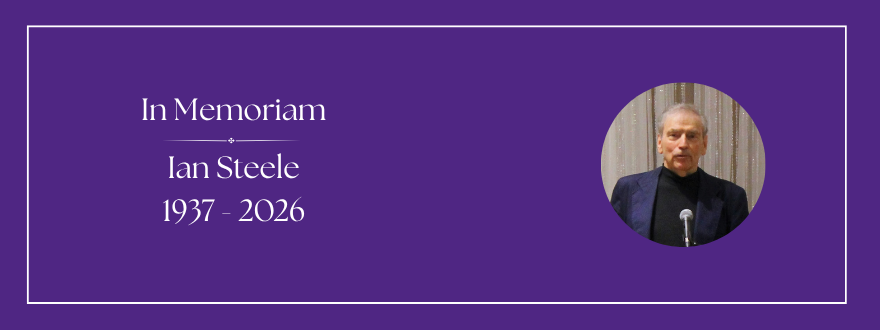
Thomas N. (Tom) Guinsburg, Professor Emeritus and Nancy L. Rhoden, Associate Professor
The unanticipated recent death of Ian Steele still reverberates like a thunderbolt to colleagues who knew him well. As his closest friend, I was the first outside his family to be informed. Almost immediately I took on the task of informing the colleague who experienced Ian’s great academic distinction most directly, Nancy Rhoden, for whom Ian was first a teacher, then a mentor, and ultimately a friend and collaborator, who coordinated the outstanding festschrift in his honor upon his retirement from the History Department.
Both of us, swallowing our grief, thought it would be useful to share our perspectives on Ian’s greatness with colleagues who knew him less well or not at all. Though he was known near and far as a scholar par excellence, those who knew him well, a much smaller group, will remember an extraordinary human being, whose courage and generosity matched his outstanding intellect.
He resolutely refused to succumb to the damage done to him by polio in his youth. And though we all were saddened at his having to deal with his handicaps, we adjusted to his seeming nonchalance and learned to shake his left hand.
Joining the History Department shortly after Ian, I soon recognized his exceptional devotion to research, which he often incorporated in his teaching, to which he was devoted as well. Nancy Rhoden has noted: “He inspired students to do their best. Strong students quickly recognized how exceptionally intelligent he was and were often eager to gain his approval because they admired him so deeply. For his part, Ian practiced student-centered learning in his undergraduate and graduate seminars by allowing students to write on anything they wanted. He certainly had broad intellectual interests, as well as the research, writing and analytical skills not only to support the students but also to inspire them.”
Though he very briefly took on administrative stints, he quickly recognized that the time required to do well in such roles would detract from his scholarly aspirations.
Ian substituted discipline for gregariousness. I do not recall that I ever saw him making small talk in the faculty lounge or attending receptions to which he was surely invited. When he had no responsibilities on campus, he stayed home to read and write.
Accordingly, Ian was not easy to get to know. The Steeles declined most invitations. They raised two steelefine sons, nurtured a menagerie of cats, collected stamps and cultivated their own gardens. The latter propensity—illustrated when the Steeles and Guinsburgs met by chance at a garden centre—was in fact the springboard of our close friendship.
Those who were fortunate—a few privileged colleagues and Ph.D. students—came to know a truly unique human being, whose intellect and scholarship were matched by his spirituality, generosity, and sensitivity. Our lengthy conversations over so many years traversed many subjects, political, cultural, and social. Never a dogmatist, he listened as well as talked.
What I saw privately transfused Ian’s scholarship, and his publications made him very influential in his field. Nancy Rhoden confirmed: “His book The English Atlantic (1986) reinvigorated transatlantic
studies and contributed vitally to the launching of the Atlantic movement in early American history and beyond.” In fact, though Ian did not wear “revisionism” on his sleeve, his curiosity and omnivalence suffused the varied subjects he touched in his many books and essays, including colonial warfare and economics and the plight of the Indigenous populations. He broke a lot of new ground.
Ian Steele was a model of a gifted academic. How fortunate we were that he spent his entire professional career in our department. Even more significant, his stature in his field never destroyed his kindness and humility. Nancy Rhoden’s personal testimony says a lot: “To him I owe more than I can explain, because his example and his encouragement have been nothing short of life changing for me.”
If few could experience that degree of impact, we all were made better by knowing Ian Steele. Sui generis as both a model academic and an extraordinary human being, he will long be remembered.