

Search Website
The Joanne Goodman Lectures
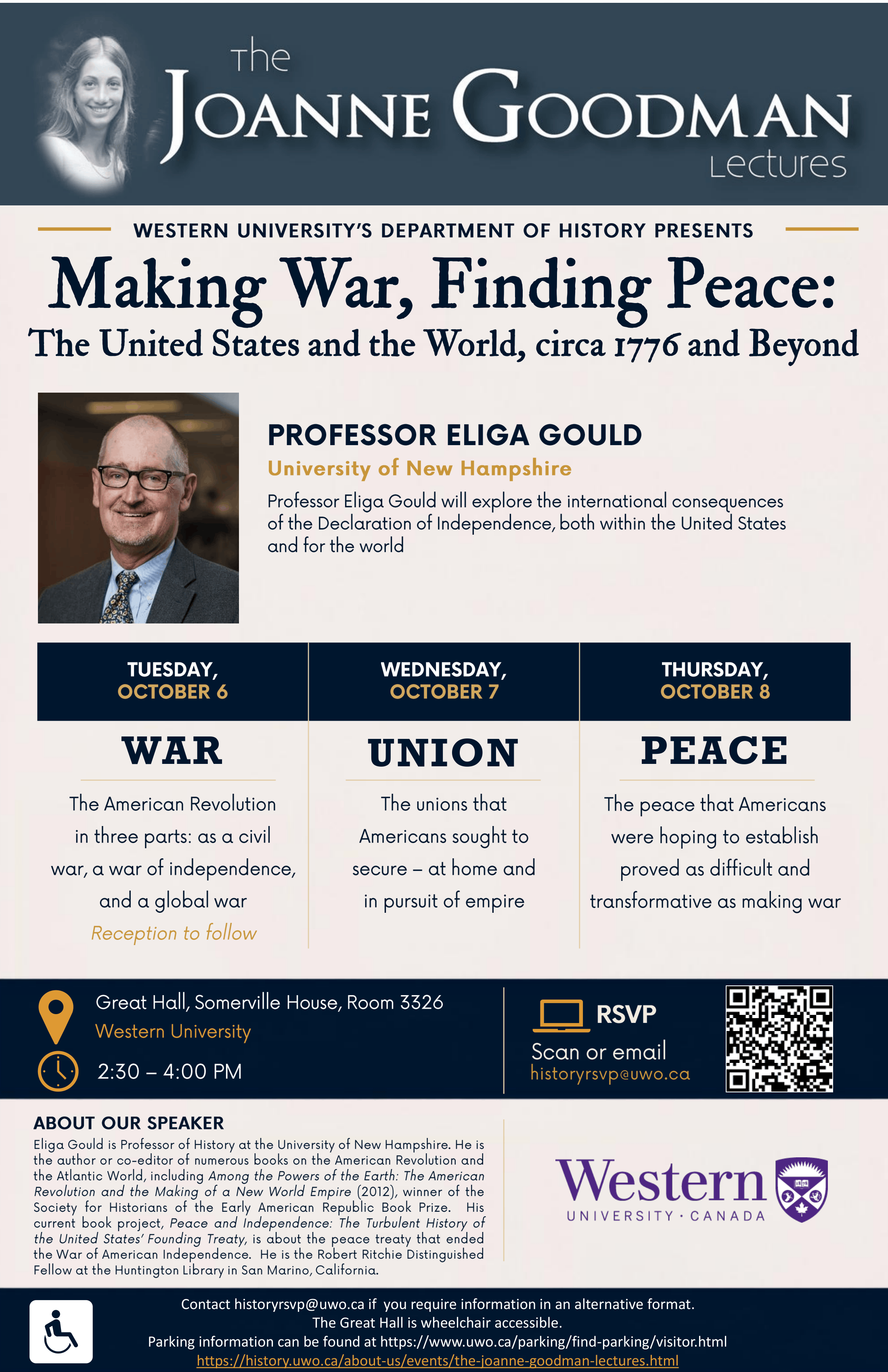
“Making War, Finding Peace: The United States and the World, circa 1776 and Beyond”
Speaker:
Professor Eliga Gould, University of New Hampshire
Dates: October 6-8, 2026
Location: Great Hall, Somerville House, Room 3326, Western University
Time: 2:30-4:00pm ET
On July 4, 1776, Congress declared that thirteen of Britain’s North American colonies were joining the powers of the earth as free and independent states. But what, exactly, did it mean to join the powers of the earth? What were the consequences for citizens of the new United States — and how did the implications differ for people on the union’s peripheries and margins, whether the margins were geographic or arose from distinctions of race, class, religion, indigeneity, and gender? In this year’s Goodman Lectures, Professor Eliga Gould will explore the international consequences of the Declaration of Independence, both within the United States and for the world that Congress proclaimed its intention to join.
October 6 – War
In the first lecture, Professor Gould will consider the American Revolution as a war with three parts: a civil war that pitted Americans against Americans, a war for independence from Britain, and — following the entrance of France and Spain — a global war in Europe, the West Indies, and Asia. Although Congress’s patriot supporters proved adept at the irregular tactics required by the first, the other two struggles required a regular army and navy, which had to be supported by taxes and public debts that American patriots objected to paying.
October 7 – Union
The second lecture will examine the various unions with which Americans hoped to secure the Revolution’s internal and external goals. In the Articles of Confederation, adopted as the union’s first constitution in 1777, the states remained free to chart their own path on a range of crucial questions, including the abolition (or not) of slavery, who had the right to vote, and whether to end public support for religion. But Congress also envisioned the United States as a continental union or empire that would someday include Canada, Britain’s other remaining North American colonies, and Indian country as far as the Mississippi River.
October 8 – Peace
In the Declaration’s conclusion, Congress promised that Americans would treat the British as they did the rest of mankind: “enemies in war, in peace friends.” In his final lecture, Professor Gould will start with the peace that Americans hoped to secure in 1776. He will then discuss the Anglo-American Treaty of Peace and Independence that Benjamin Franklin, John Adams, and John Jay, signed in Paris on September 3, 1783. As the history of the United States’ founding treaty shows, finding peace turned out to be at least as difficult and transformative as making war.
About Our 2026 Speaker: Professor Eliga Gould
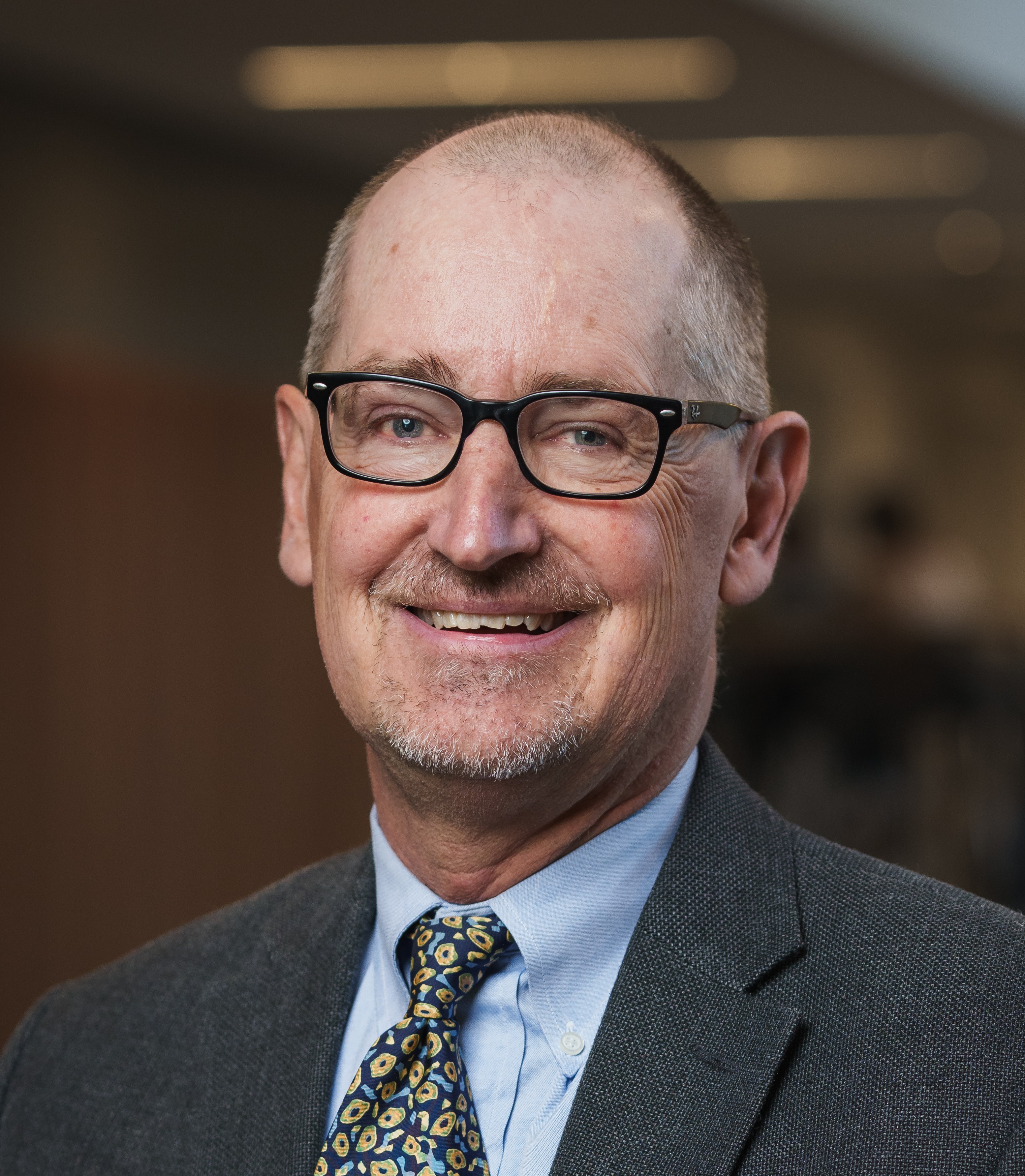
Eliga Gould is Professor of History at the University of New Hampshire. During the 2025-26 academic year, he was Harmsworth Visiting Professor of American History at the University of Oxford. He has written extensively on the American Revolution, emphasizing the entangled history that Americans shared with the rest of the Americas, as well as with Africa, Europe, and the wider world. His books include The Persistence of Empire: British Political Culture in the Age of the American Revolution (2000), winner of the Jamestown Prize from the Omohundro Institute, Empire and Nation: The American Revolution in the Atlantic World (2005), co-edited with Peter S. Onuf, Among the Powers of the Earth: The American Revolution and the Making of a New World Empire (2012), which won the Society for Historians of the Early American Republic Book Prize and was a finalist for the George Washington Book Prize and a Library Journal Best Book of the Year, and the first volume of The Cambridge History of America and the World (2021), co-edited with Paul Mapp and Carla Gardina Pestana.
Professor Gould has held long-term fellowships from the John Simon Guggenheim Memorial Foundation, the National Endowment for the Humanities (twice), the International Center for Jefferson Studies at Monticello, the Charles Warren Center for the Study of American History at Harvard University, and the Fulbright-Hays Program to the United Kingdom. He graduated from Princeton University summa cum laude, followed by graduate study at Edinburgh and Johns Hopkins, where he received his PhD. In 2026-27, he is the Robert Ritchie Distinguished Fellow at the Huntington Library in San Marino, California. His current book project, Peace and Independence: The Turbulent History of the United States’ Founding Treaty, is about the peace treaty that ended the War of American Independence.
About the Joanne Goodman Lecture Series
Every autumn a distinguished historian is invited to Western University to deliver three public lectures on consecutive afternoons to students, faculty and members of the London community. The lecture series was established in 1975 by the Honourable Edwin A. Goodman and his family of Toronto to perpetuate the memory of their beloved elder daughter, a second year History student who died in a highway accident in April of that year.
The theme of the series is the history of the Atlantic Triangle (Canada, the United States and the United Kingdom). The first lectures were given in 1976 by the leading Canadian military historian, Colonel Charles Stacey, on 'Mackenzie King and the Atlantic Triangle'. Occasionally there have been lectures outside the general framework. In 1995, for example, the topic was 'The Birth of the "New" South Africa', tracing the collapse of apartheid and the construction of a new political and social system since 1990, by Rodney Davenport, a South African historian and opponent of apartheid.
The endowment also supports publication so that these important lectures may be shared by a readership well beyond the immediate audience at Western University. Most of the lectures have been published as books, either in a form similar to lectures or as part of a larger work. The lectures are widely recognized as being the most important history lecture series in Canada. The invitation to deliver them and the publications that result are highly regarded in this country and around the world.
Past Speakers
To see a list of our past Goodman Lecturers, click here. Many of the lectures are also available as books, please click here for a list.
In The News
(Oct 31, 2025) The Gazette - "From past to present: The state of democracy" [Read Article]
(Sep 23, 2025) CBC Radio London – London Morning with Andrew Brown
(Oct 20, 2023) “From Studying at Western ….her story.” [Read Article]
(Oct 1, 2019) CBC Radio London – London Morning with Rebecca Zandbergen
(Oct 3, 2018) CBC Radio London – London Morning with Julianne Hazlewood
(Sep 24, 2017) The Gazette – "Popular history comes to 2017 Joanne Goodman Lectures" [Read Article]
(Sep 21, 2016) Western News – "Making a Middle Ages connection in politics" [Read Article]
(Sep 20, 2012) Western News – "Goodman Lectures create a legacy from tragedy" [Read Article]
Accessibility
Contact the History Department at history-inquiries@uwo.ca if you require information in an alternate format, or if any other arrangements can make this event accessible to you. For a campus accessibility map please visit: http://www.accessibility.uwo.ca/resources/maps/index.html.
The Great Hall is wheelchair accessible (follow the posted signs).
Parking
Parking information can be found at https://www.uwo.ca/parking/find-parking/visitor.html.