

Search Website
Tools of the Trade
Over the course of the last century, historians at Western have used a variety of tools in their efforts to research, understand and explain the past. The artifacts below reflect some of the 'new' technological tools that changed the way historians worked and the kinds of history they produced.
This exhibit was created by students in Professor Mike Dove's 2016-2017 HIS3813E public history class:
Sarah Crook, Sunny Kim, Amy O'Shea and Sasha Potter.
They are grateful for the assistance of Professor Dove, classmate Mackenzie Brash, Ph.D Candidate Elliot Worsford, Department Assistant Chris Speed, Finance & Web Assistant Dennis Sue, Professors Michelle Hamilton, Alan MacEachern, Peter Krats, James Flath, Bill Turkel and Karen Priestman, Department Chair Francine McKenzie, and Professors Emeriti Roger Emerson and Ian K. Steele.
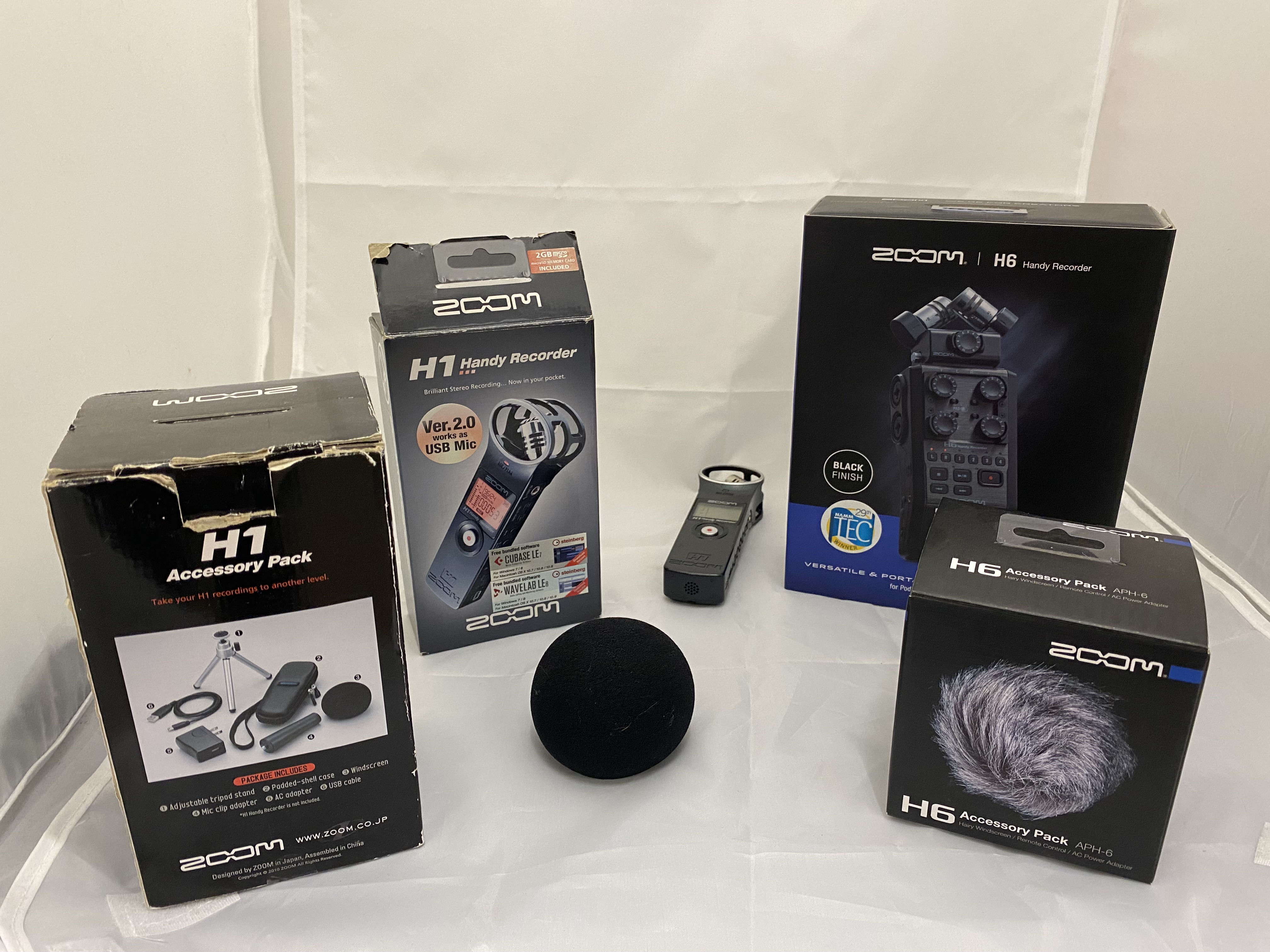 |
ZOOM H1 Handy Recorder with windscreen on adjustable tripod stand, 2010The emergence of social history in the 1960s encouraged historians to employ oral history interviews to document the stories of those previously underserved by traditional approaches. Audio recordings originate as far as back as the 1880s, when the spoken word was recorded on wax cylinders. This digital version replaced the analog audio storage devices that included the cassette tape recorder in use by the late 1960s and the portable micro cassette voice recorder of the 1970s and 1980s. Digital micro recorders emerged in the late 1990s, making audio files easier and quicker to analyze. They also stored significantly more data. This model for instance can hold close to 70 interview hours, compared to just the 1 hour of storage capacity on its analog predecessor. On loan from Professor Bill Turkel. |
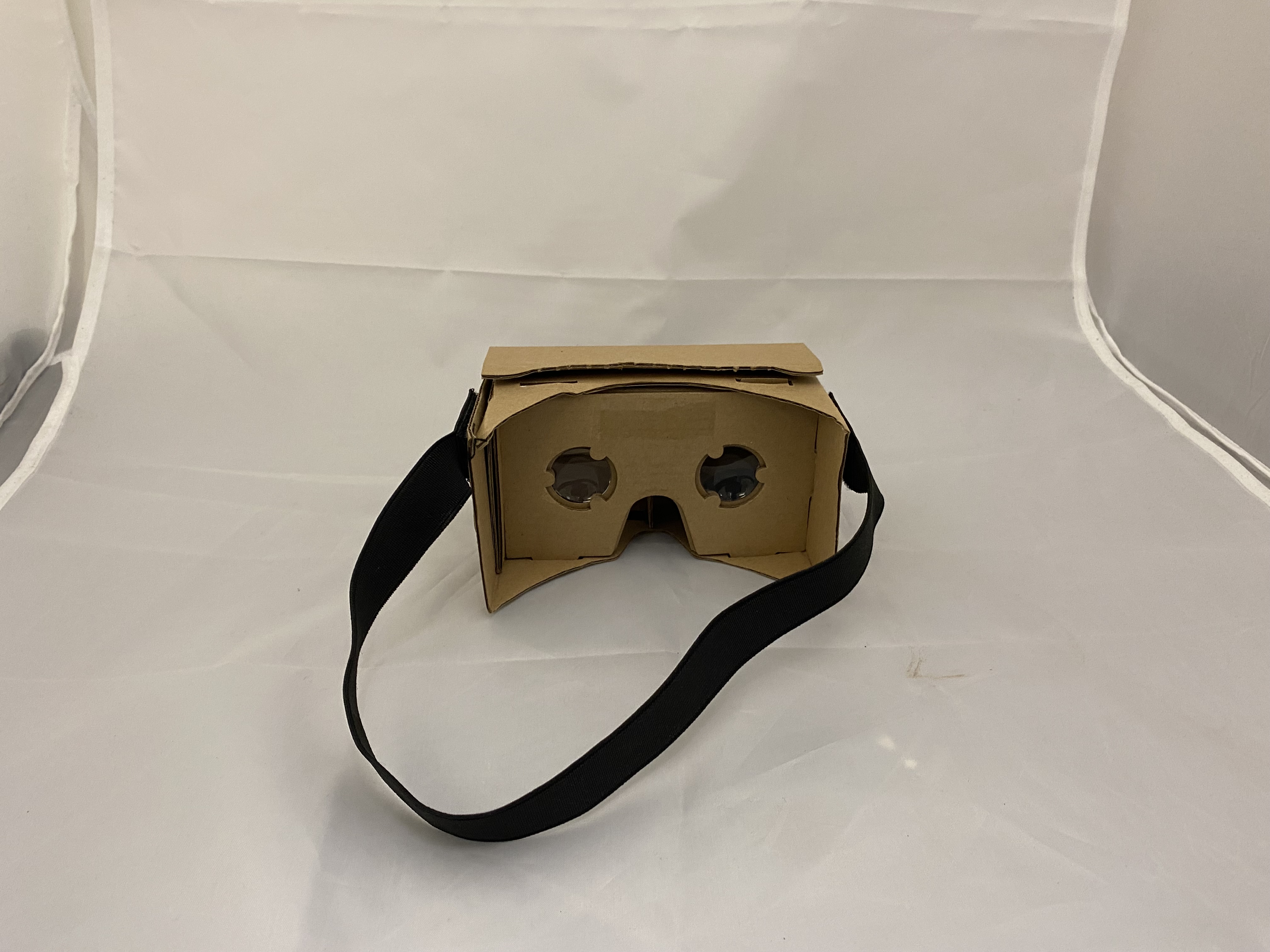 |
Cardboard HeadsetGoggle cardboard headsets offer people an affordable low-barrier virtual reality (VR) experience. It turns your smartphone into an immersive headset using custom lenses and your phone’s built-in sensors. |
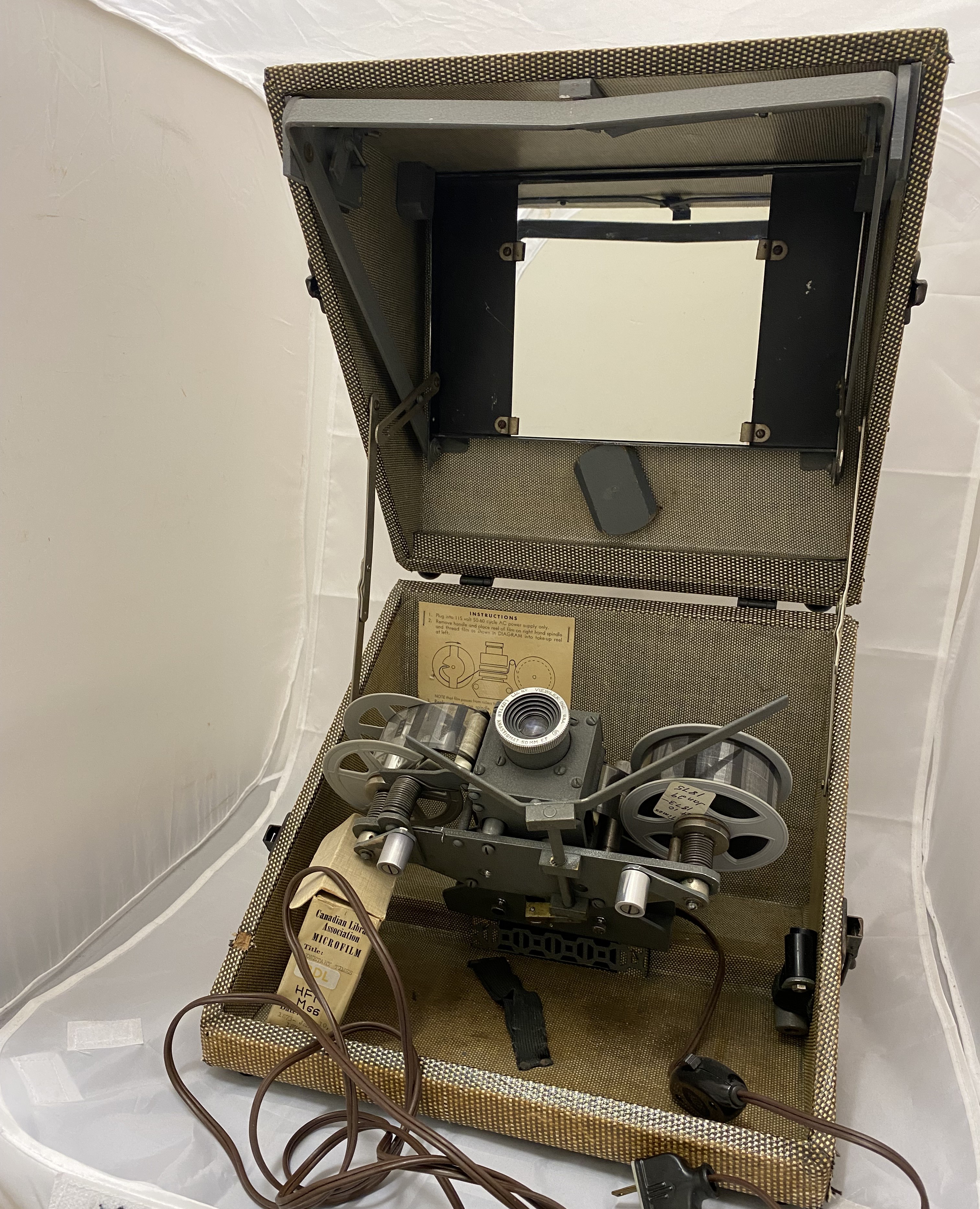 |
Griscombe Portable Microfilm Reader, c. 1950Historians have been heavy users of microfilm for access to primary sources since the format became commercially available in the 1920s. The advent of roll or reel microfilm, acceleration of major document filming projects, and the appearance of portable microfilm readers over the next quarter century had enormous research ramifications for historians in terms of access, cost and convenience. Microfilmed document collections now could be borrowed from archives around the world, saving the time and expense of travel, and examined in the comfort of one's home or office. The model shown here was designed for desktop use and projected the microfilmed image on either the fold-away screen provided with the unit, or on any light coloured surface such as a wall or table-top. Professor Ian K. Steele (faculty member 1964-2004) purchased this reader second hand in the 1960's from Hay's Stationery for approximately $100. |
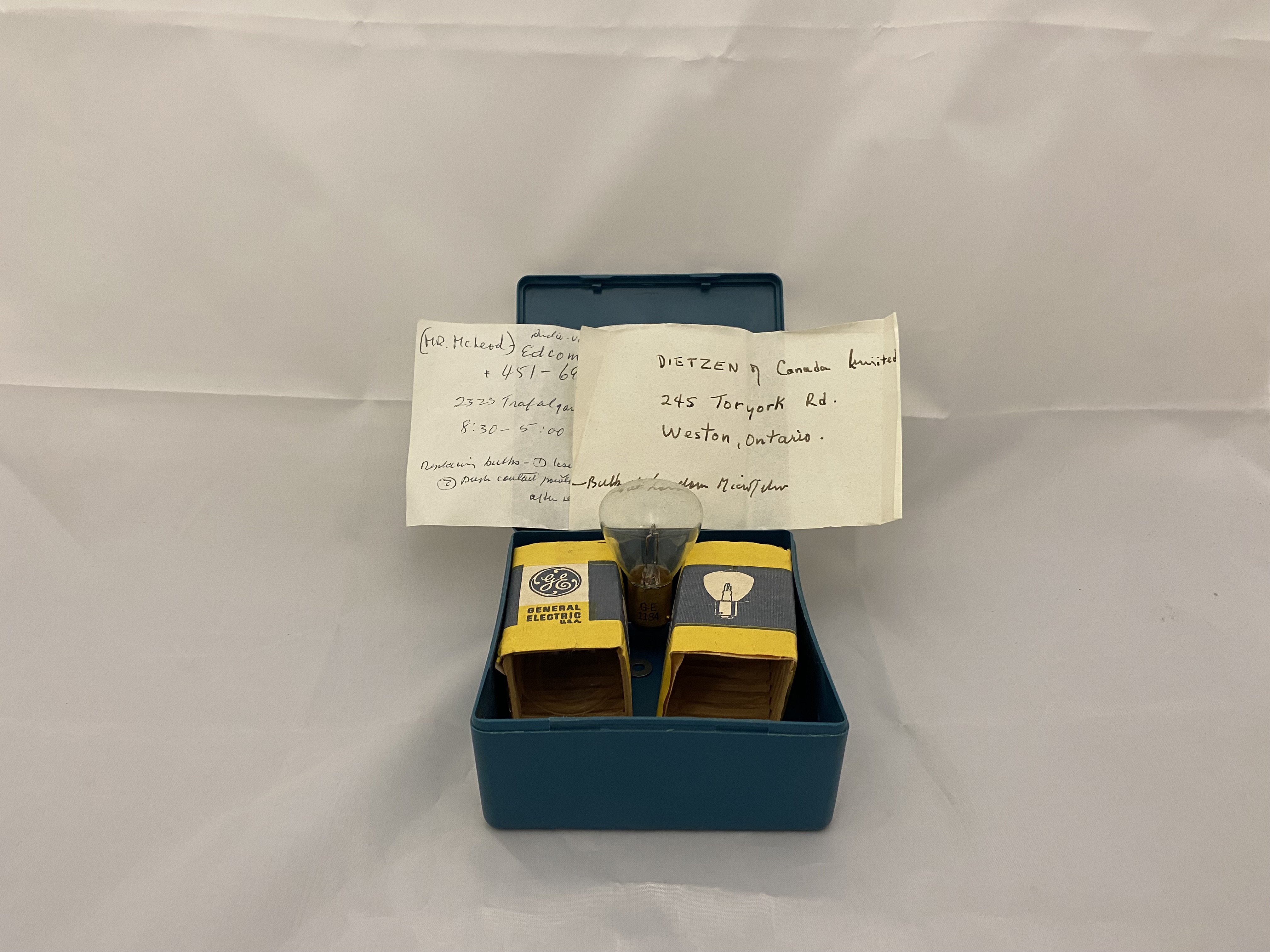 |
Replacement Bulb for Microfilm ReaderPurchased from Dietzen of Canada Limited, 245 Toryork Rd. Weston Ontario. Each bulb was only good for approximately 100 hours of viewing. |
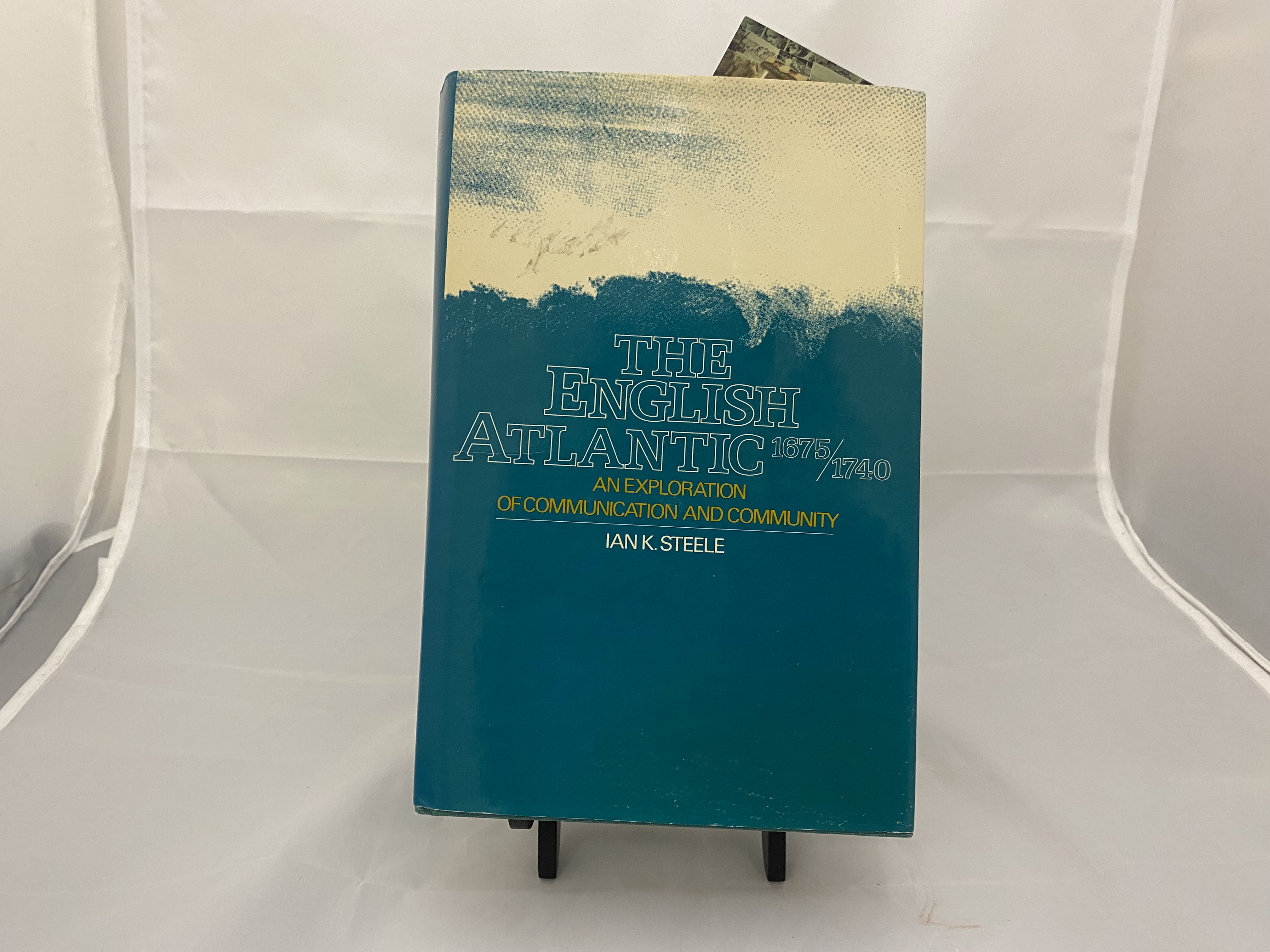 |
"The English Atlantic 1675/1740 An Exploration of Communication and Community", by Ian K. Steele Over a period of 20 years, Professor Steele conducted extensive research for this book using the microfilm reader displayed above. He examined records obtained from archives across Canada, Britain, and the United States, along with microfilm borrowed through interlibrary loan services, including materials from the National Archives of Canada.
|
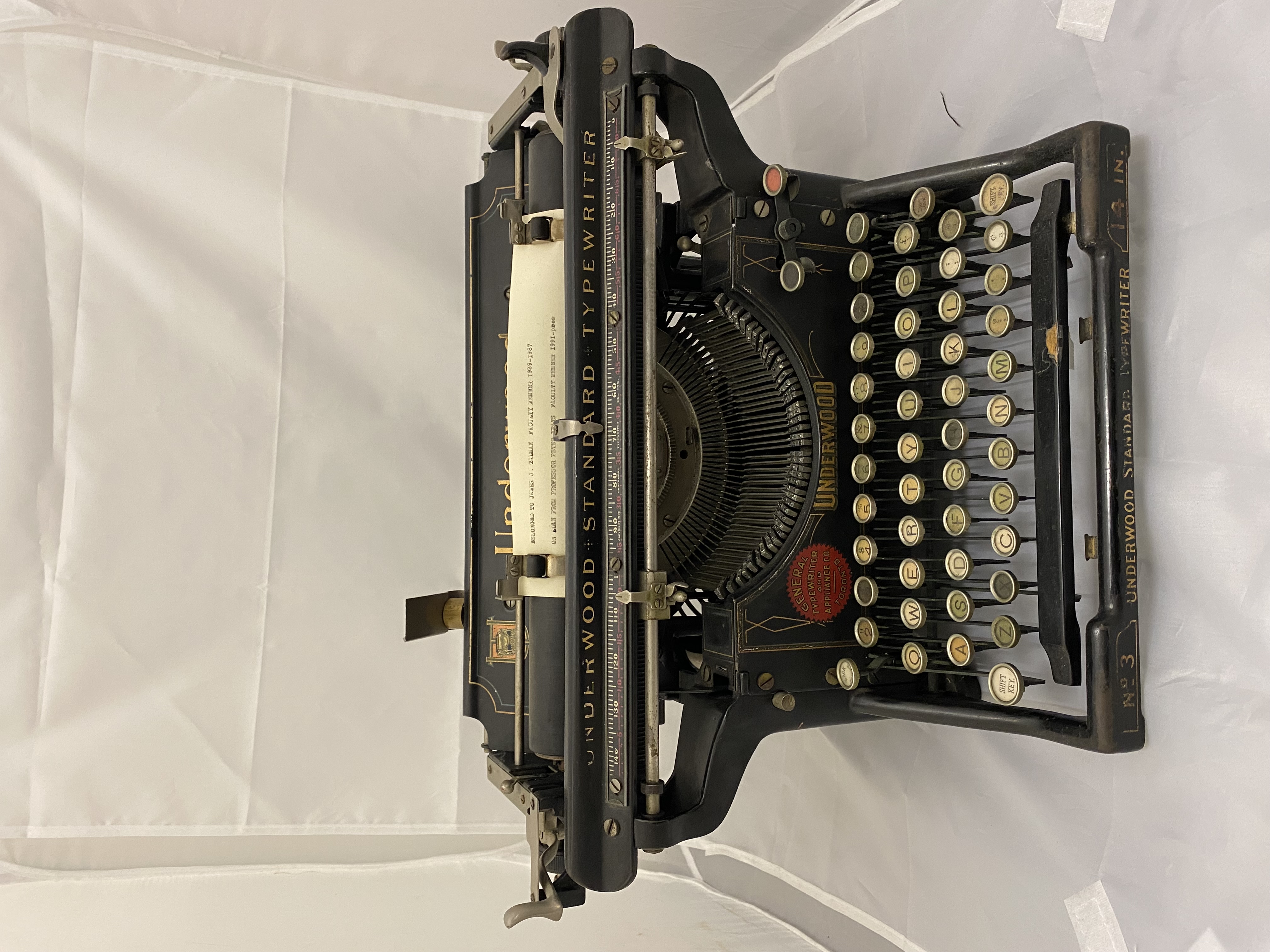 |
Underwood Typewriter No. 3, 1920Typewriters are one of the longest lasting technologies of the modern era. Mechanical writing quickly replaced handwriting in business, government and university record-keeping by the first decade of the twentieth century. Text was produced more quickly than by hand, and multiple copies could be made with the introduction of carbon paper and stencils. Another advantage of the type-written word was in its appearance- a uniform font type and size, which could be widely read and understood. The format greatly accelerated the process of publishing one's research. The American-based Underwood Company produced what is considered to be the most successful typewriter in history. In design and function, it became the standard for all manual typewriters. The model shown here, manufactured in Toronto, is a No.3 wide carriage (14-inch) machine, which allowed for larger size paper than the typical o-inch carriage typewriters. Belonged to James J. Talman, faculty member 1939-1987. On loan from Professor Peter Krats, faculty member 1991-2025 |